As the saying goes, if you make a fool pray to God, he will smash his forehead. This perfectly describes what Laos and a number of other countries have done with renewable energy: a good idea has turned into an ecological disaster. Vietnam suffers from this the most, but the Vietnamese themselves are sacrificing the lower reaches of the Mekong for energy, which is no longer renewable.
The scale of the disaster
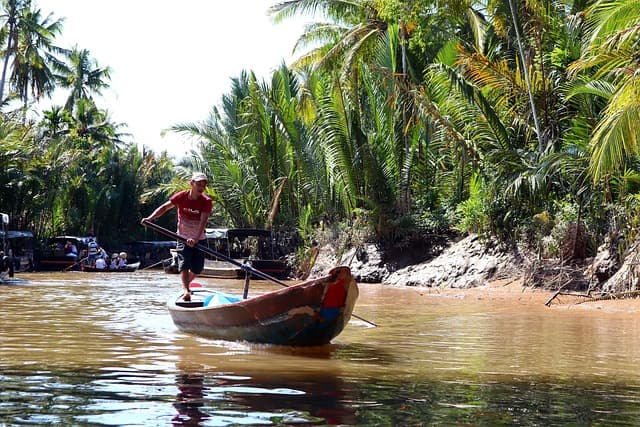
People living along the banks of the Mekong River in Laos and Thailand were recently amazed to see that the water in the river had turned light blue and was so clear that they could see the sandbanks beneath it. It was a breathtaking sight; the phenomenon stimulated tourism in the area. Yet the blue water is bad news. It indicates that the river is undergoing an ecological disaster. The Mekong is usually reddish-brown in color as a result of nutrient-rich silt and sediment that permeates the river water. Nutrients such as phosphorus and nitrogen, which absorb silt, are carried by the water flow from upstream to downstream, all the way to the open sea in the Mekong Delta in Vietnam.
Experts blame the countless dams being built upstream in China and Laos. Thanks to heavy investment from China, Laos, a landlocked mountainous country, is seeking to become the “battery of Asia” with new hydroelectric power plants built on local rivers, including tributaries of the Mekong.
Geopolitics and ecology
The recent decision by Vietnam’s Petrovietnam oil company to invest in the construction of a huge dam near the UNESCO World Heritage site in Luang Prabang, Laos, has caused confusion and concern among many Mekong experts, civil society groups, and some government officials in Hanoi. The cascade of dam construction projects on the lower Mekong in Laos has prompted repeated expressions of critical concern from Vietnam, as its delta is highly vulnerable to the destructive effects of dams downstream. Back in 2011, Vietnam’s former prime minister publicly called for all construction work on the Xayaburi dam to be halted. Vietnam also called on Laos to review all subsequent dams.
However, the Vietnamese government has now switched sides and is promoting the largest dam on the lower Mekong, the 1,410 MW Luang Prabang Dam.
The Luang Prabang Dam is the fifth hydropower project submitted by Laos to the Mekong River Commission for preliminary consultation with the three other riparian states (Cambodia, Thailand, and Vietnam). The four previous dam projects were criticized by Vietnam on the grounds that they prevented nutrient-rich sediments from entering the fragile delta ecosystem.
The striking reversal prompted the online newspaper VN Express to call the move “Vietnam shooting itself in the foot” in a post that was later removed from the site. The shift to the Luang Prabang dam threatens Hanoi’s diplomatic authority at a time when Southeast Asia’s longest river is still struggling to recover from a severe drought in July that led to a sharp decline in fish stocks. Water levels in the Mekong remain alarmingly low during the current dry season, and monsoon rains are not expected until June next year. Many provinces in Cambodia and Thailand have declared water shortages.
Mark Goysho, a water resources specialist at the World Wildlife Fund, warns that the costs of promotion will be very high for both Laos and Vietnam.
According to the revised Energy Development Master Plan for 2011–2020 with a vision to 2030, 12 coal-fired power plants with a total capacity of 15,780 MW are planned to be built in the Mekong Delta region. If the river water temperature is around 25–27 °C in winter or up to 32 °C in summer, and the discharged cooling water is approximately 7 °C higher, several sections of the Mekong River will suffer from thermal pollution. If all the plants are built, the total volume of cooling water discharged from them will reach 21.8 billion cubic meters per year in 2020–2050. Compared to the total volume of water that the Mekong River discharges into the sea (about 475 billion cubic meters per year), the volume of cooling water will be equal to 4.5%, which is quite a significant amount.