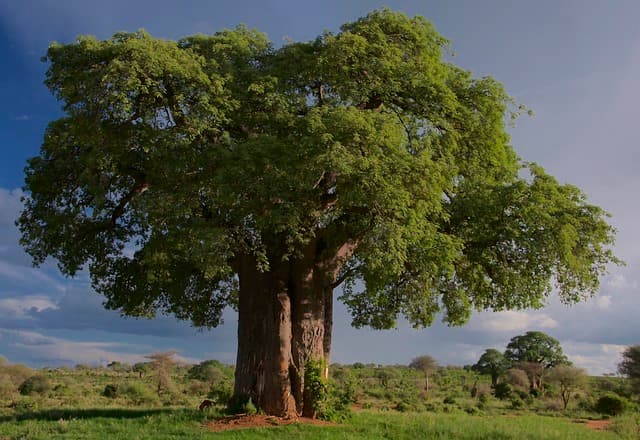
The baobab (Adansonia digitata) is a massive tree that is widespread in the dry savannas of Africa, including the Congo region. These giants can reach heights of up to 25 m, but their trunks are particularly impressive: up to 10–14 m in diameter, they can store up to 120,000 liters of water, acting as natural reservoirs.
The trunk is bumpy and porous, capable of retaining the moisture needed during the dry season — part of its tissue structure performs photosynthesis even without leaves.
Their role in the ecosystem
Water reserve
Baobabs act as natural reservoirs: they absorb water during rains and slowly release it back into the soil, helping other plants survive during unfavorable periods.
Soil stability and nutrition
The roots of giant trees strengthen the soil, preventing erosion on slopes and banks. Fallen leaves and fruits return essential nutrients to the soil — an important process in depleted ecosystems.
Shelter and food for animals
- Hollows in tree trunks are used by birds, bats, small mammals, and reptiles.
- Night-blooming flowers, up to 80% of which are pollinated by bats, serve as food for these same pollinators.
- The fruits, along with their skins and seeds, feed elephants, baboons, monkeys, and birds. Animals, especially elephants, participate in seed dispersal — a simple example of interdependence.
Value for humans
Food and medicine
- The fruits are true “superfoods”: they contain six times more vitamin C than oranges and are rich in antioxidants and fiber.
- The leaves are consumed like spinach, the crushed seeds are used as oil and a coffee substitute, and the bark is used to make fabrics, ropes, baskets, and traditional medicines.
Economic significance
From 2013 to 2017, baobab exports grew from 50 to 450 tons and are expected to reach 5,000 tons. Fruit and oil production provides income for rural communities.
Cultural heritage
The baobab is a symbol of resilience and life. The trees are often used as landmarks, meeting places, and sites for spiritual ceremonies. Local legends explain their bizarre appearance with tales of upside-down roots.
Threats and challenges
- Climate change — in recent years, there have been reports of ancient baobabs, up to 3,000 years old, dying, presumably due to drought, heat stress, or infections.
- Damage caused by animals and humans — elephants piercing the bark in search of water, as well as excessive logging for economic purposes, weaken the trees.
- Threats to the ecosystem — the loss of baobab trees will lead to soil erosion, reduced biodiversity, and worsened food security in the regions.
Protective measures
- Ecological restoration: programs such as those in the Okavango Delta aim to protect ancient trees and restore plantings.
- Sustainable exploitation: research confirms that bark regenerates after removal, so traditional practices can be sustainable if managed wisely.
- Community and traditions: involving local people in the protection of valuable old trees and creating economic incentives linked to sustainable production.
Prospects
Baobabs are a key element of ecosystems in Africa, including the Congo. Their conservation requires a comprehensive approach: scientific monitoring, the implementation of traditional practices, and sustainable commercial development. These “trees of life” are not just symbols, but the foundation of living, economically sustainable, and ecologically balanced landscapes.