Forest cats of Southeast Asia are among the most secretive and underrated predators in tropical ecosystems. These animals are rarely seen by humans, are predominantly nocturnal, and are well adapted to life in dense jungles, where humidity, dense vegetation, and numerous competitors for food prevail. Despite their important role in natural food chains, they remain poorly studied and are increasingly threatened with extinction due to human activity.
The forest cats of the region include species such as the flat-faced cat (Prionailurus planiceps), the marbled cat (Pardofelis marmorata), the clouded leopard (Neofelis nebulosa), the golden cat (Catopuma temminckii), Asian fishing cat (Prionailurus viverrinus), leopard cat (Prionailurus bengalensis), and the extremely rare Bornean cat (Catopuma badia). Each of these species has unique adaptations and behavioral characteristics that help them survive in challenging conditions.
The flat-faced cat, for example, specializes in catching fish and other aquatic animals. It has a flattened muzzle, sharp claws, and semi-webbed paws, which enable it to hunt in swampy areas and along rivers. This species has hardly been studied in the wild: most of the data has been obtained from surveillance cameras and rare observations, and it is found only in certain areas of Borneo, Sumatra, and the Malay Peninsula. Today, the flat-faced cat is on the verge of extinction — the main threats to it are habitat destruction and water pollution.
The marbled cat, which inhabits forests from Nepal to Borneo, has a long tail that helps it maintain balance when moving through trees. It is an exclusively arboreal animal, capable of jumping from branch to branch like a monkey. Thanks to its spotted, “marbled” coat pattern, the cat is perfectly camouflaged in the shade of the foliage. Due to deforestation, marbled cats are losing their habitat and are increasingly facing threats from humans, including poaching.
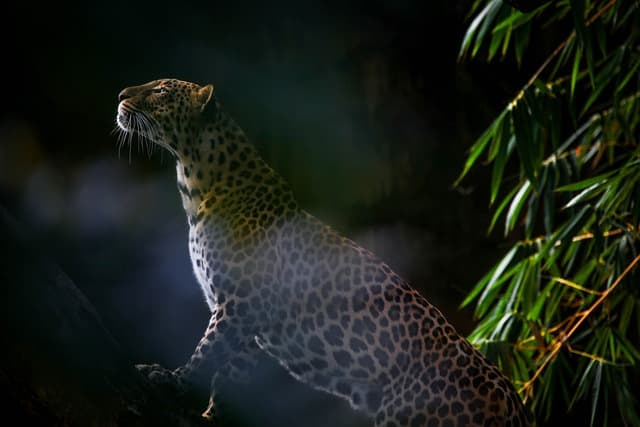
Despite its name, the clouded leopard is not directly related to real leopards. It is a medium-sized predator with long fangs resembling those of saber-toothed cats. It inhabits areas from eastern India to southern China, including Thailand, Myanmar, and Malaysia. Thanks to its powerful limbs and flexible ankles, the clouded leopard can easily climb trees and hunt monkeys, birds, and small ungulates. However, even such a powerful predator is vulnerable: the population of this species is declining due to deforestation and hunting for its fangs and skins.
Equally interesting is the Bornean cat, endemic to the island of Borneo and one of the rarest wild cats in the world. It has dark fur with a reddish tinge, a long fluffy tail, and large eyes adapted to night vision. This species is considered a mystery to scientists: less than 30 reliable observations have been made in the wild since its discovery. It leads an extremely secretive lifestyle, preferring dense primeval forests, and almost never approaches human settlements. Its disappearance would be an irreparable loss to the world’s fauna.
A common feature of all forest cats in Southeast Asia is their high degree of specialization and attachment to virgin tropical forests. However, it is these forests that are rapidly disappearing. Large-scale logging for palm oil, illegal hunting, and the development of agriculture and infrastructure make the survival of these cats extremely difficult. In addition, many species suffer from habitat fragmentation, which makes it difficult to find mates and increases the risk of inbreeding.
The conservation of forest cats requires a comprehensive approach: from protecting old-growth forests and creating ecological corridors to strict control over poaching and educating the local population. Some organizations in the region are already working on population monitoring and restoration programs, using camera traps, satellite tracking, and genetic analysis to study these little-known animals. But this is not enough — the international community must also pay attention to these endangered predators, which, despite their secretive nature, play an important role in maintaining the balance of tropical ecosystems.
The forest cats of Southeast Asia are not just rare and beautiful animals. They are living symbols of the richness and vulnerability of tropical forests. Their disappearance would be an alarming sign that the region’s natural systems are rapidly losing their stability. The conservation of these secretive predators is not only a matter of biological diversity, but also a moral responsibility of humans towards wildlife.