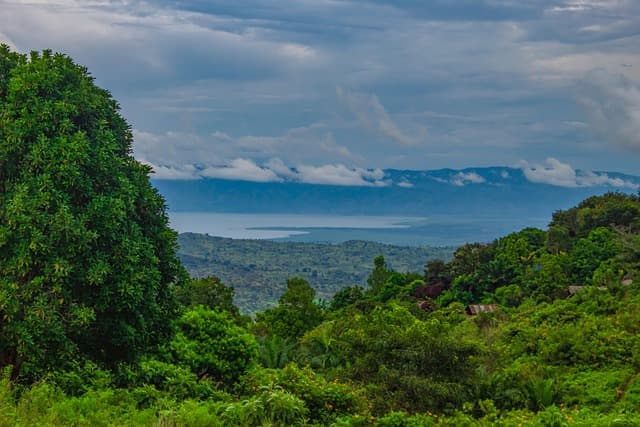
Deforestation in the Congo Basin, the world’s second largest tropical forest, is releasing carbon into the atmosphere that has been stored in the soil for hundreds and thousands of years. This is according to a study by scientists at Florida State University, published in a journal.
Soils contain enormous amounts of carbon — more than the atmosphere and living vegetation combined. About a third of this carbon is contained in tropical soils that have been covered by jungle for hundreds of years. Deforestation for agriculture and population growth leads to the release of this carbon.
The researchers took river water samples from 19 sites in the Kivu region of eastern Democratic Republic of Congo, representing a gradient from intact forests to completely deforested areas. Scientists estimate that between 2000 and 2010 alone, nearly 1,500 square kilometers of forest were cleared in this region.
After analyzing the samples, the scientists determined the age of the radiocarbon and the chemical composition of the dissolved carbon that leaches into rivers from nearby soils. While young forests mainly released carbon collected through photosynthesis into the atmosphere, the soils under completely deforested forests contained carbon that was 1,500 years old.
Researchers believe that the region contains about 20 billion tons of ancient carbon, and its release into the atmosphere will accelerate global warming.
Earlier, it was reported that humanity has destroyed 90% of grasslands and wild pastures. According to scientists, prairies are disappearing faster than forests in the Amazon region. The reason for this is human activity — agriculture.